

Keelith
A production-oriented Go framework for distributed microservices, giving generated services one consistent way to handle transport, configuration, governance, background work, and observability.
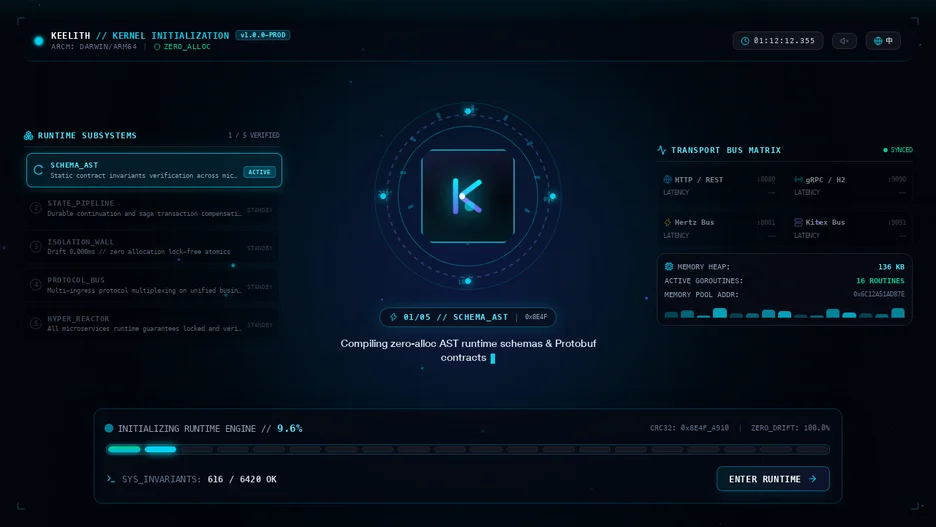
Keelith is a contract-first Go runtime for production microservices, giving code-generated services a single consistent way to compose HTTP and gRPC transports, middleware, configuration, service discovery, governance policies, background work, observability, and graceful lifecycle management. It is intentionally modular: applications start from its core contracts and add only the integrations they need, keeping infrastructure-specific dependencies at the edge in separate optional modules.
Its features include one deterministic application lifecycle for startup, readiness, graceful shutdown, and bounded cleanup, transport-neutral contracts shared across HTTP, gRPC, and other transports, covering operations, metadata, errors, validation, identity, and placement, composable governance such as timeout, retry, hedging, circuit breaking, bulkheads, rate limiting, load shedding, admission control, fallback, and outlier detection, programmable workloads such as durable continuations, projections, topology plans, sagas, jobs, workers, cache invalidation, and idempotency primitives, and observability by default through structured logging, metrics, tracing, health checks, and secret-free runtime descriptions. It requires a recent Go version, and a CLI scaffolds a minimal runnable HTTP service from generated bindings.