

Kyros
An open-source memory system for AI agents that gives them persistent episodic, semantic and procedural memory, with cryptographic integrity proofs and automatic decay and conflict resolution over time.
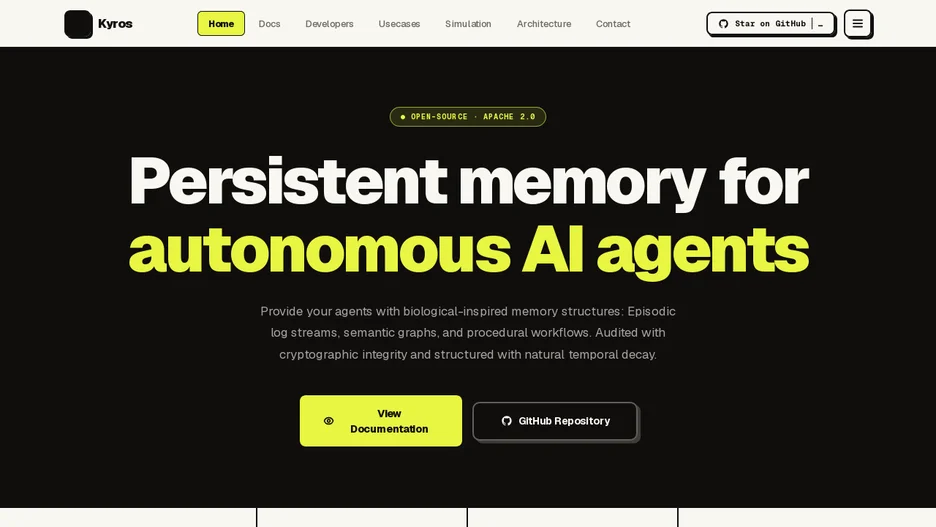
Kyros stores three memory types modeled on cognitive science research: episodic memory for events and experiences, semantic memory for facts and preferences, and procedural memory for skills and workflows. Every memory is protected with SHA-256 hashing and Merkle tree proofs, giving tamper detection, authenticity verification and an audit trail across its history.
Memories fade over time following Ebbinghaus decay curves with category-specific half-lives, for example a much shorter half-life for market data than for user identity facts, which keeps the store from growing without bound. When new facts conflict with stored ones, a belief-propagation mechanism updates confidence scores across the semantic graph automatically. It is exposed as a model-agnostic REST API with Python and TypeScript SDKs, and is deployed with Docker alongside FastAPI, PostgreSQL and Redis.