

Langfuse
An open-source LLM engineering platform for tracing, evaluating and debugging AI applications, with prompt version management and an interactive playground for iterating on prompts.
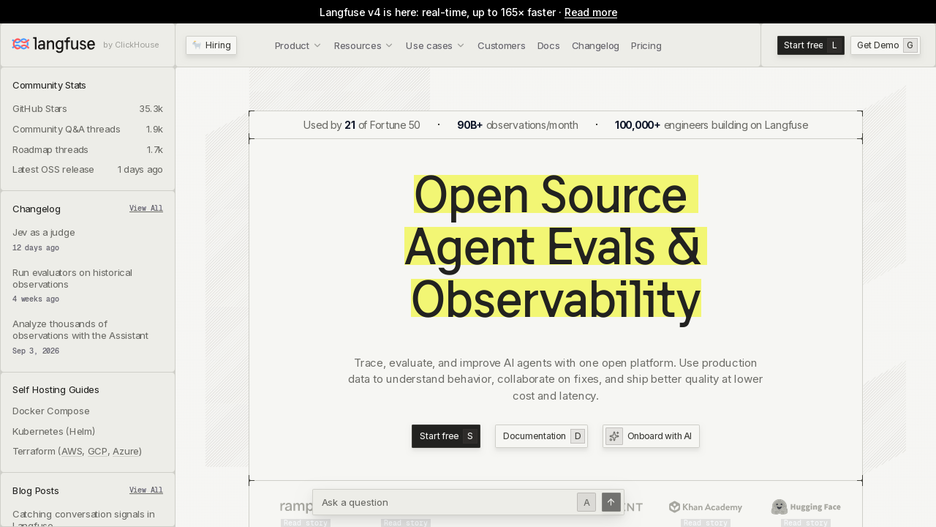
Langfuse ingests traces from an instrumented application to track LLM calls alongside related logic such as retrieval, embedding or agent actions, so a session or a bad result can be inspected and debugged. Prompt management centrally versions prompts for collaborative iteration, with server- and client-side caching to avoid added latency. Evaluation is supported through LLM-as-a-judge, code-based evaluators, user feedback collection, manual labeling and custom pipelines built on its API, and datasets let a team build test sets and benchmarks for pre-deployment testing and structured experiments. A built-in playground lets a user jump from a bad traced result directly into iterating on that prompt and model configuration.
It integrates with frameworks such as LangChain and LlamaIndex, and exposes an OpenAPI-documented API with typed Python and JS/TS SDKs. It can be used as a managed Langfuse Cloud service, or self-hosted with Docker Compose, on a single VM, on Kubernetes via Helm, or through Terraform templates for AWS, Azure or GCP; it is built on the ClickHouse open-source database.
It is written in TypeScript.