

LEANN
A vector database that indexes and semantically searches millions of personal documents on a laptop using about 97 percent less storage than conventional vector databases, without losing search accuracy.
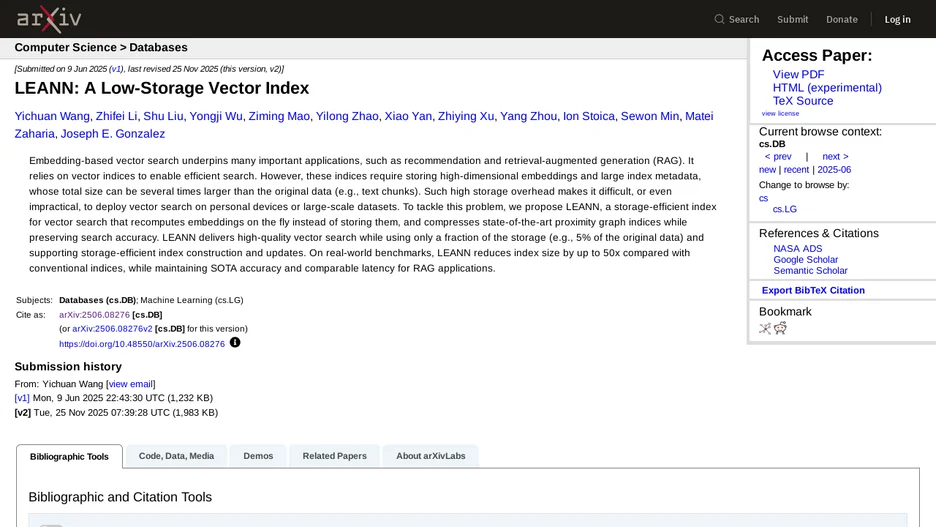
LEANN is a vector database designed to make retrieval-augmented generation practical on a single laptop. Instead of storing every embedding, it uses graph-based selective recomputation with high-degree-preserving pruning to compute embeddings on demand, which the project reports cuts storage by about 97 percent compared with conventional vector databases while keeping the same search accuracy; in one reported benchmark, 60 million text chunks fit in about 6 gigabytes instead of roughly 201 gigabytes.
It can index and semantically search a personal file system, emails, browser history, chat history from apps such as WeChat and iMessage, agent memory from assistants such as ChatGPT and Claude, or external knowledge bases running to tens of millions of documents, entirely on-device with no cloud dependency, and can move an entire indexed knowledge base between devices.
Because Claude Code's own built-in search is limited to grep-style keyword matching, LEANN also ships as a drop-in semantic-search MCP service that plugs into Claude Code to add intelligent retrieval without changing an existing workflow.