

llmaker
A CLI that provisions and operates a complete self-hosted LLM application stack, including models, vector databases, embeddings, caching and observability, on one private Docker network from a single command.
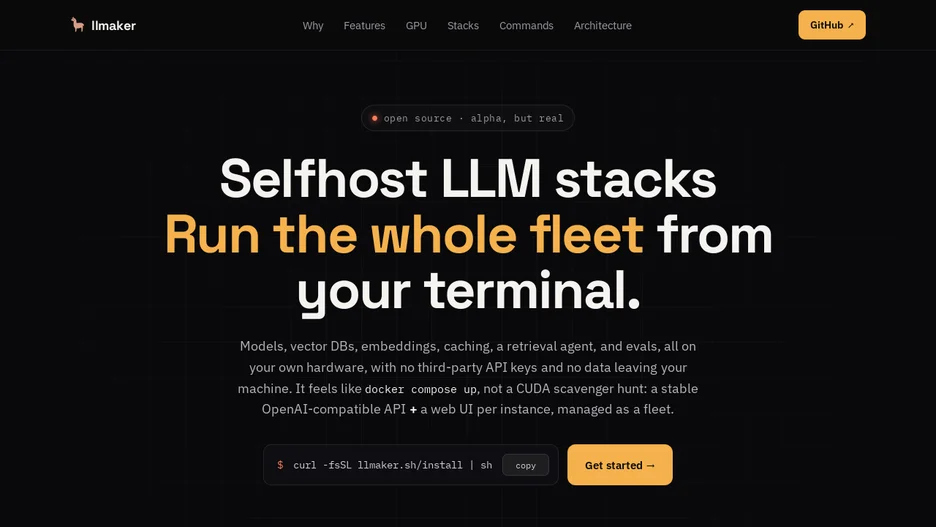
llmaker provisions and runs a modern LLM stack on a user's own infrastructure: large language models, vector databases, an embedding service, caching, observability, and a retrieval and agent layer, networked together and operated as one fleet from a single CLI, with live status, logs and a resource dashboard across every model and service.
Stacks are declarative and reconcilable, so applying a stack again brings it in line with its definition, including pruning containers that no longer belong. Models are exposed through an OpenAI-compatible interface, and retrieval requests are traced automatically. Every model and service joins a private Docker network and resolves other members by name, with no manual IP configuration or Compose file needed; grouping containers under one network name isolates a stack so nothing outside the group can reach it, and empty group networks are cleaned up automatically. A catalog covers vector databases such as Qdrant, Chroma, pgvector and Weaviate, plus Redis, embeddings, a web chat UI, workflow tools, and speech and tracing services, and GPUs on a multi-GPU machine can be split into exclusive, labeled partitions between instances.
The goal is to build private retrieval-augmented chatbots, FAQ assistants and recommendation engines locally, without third-party API keys or data leaving the machine.