

Mainline
A tool that lets AI coding agents save engineering intent and decisions to Git alongside the code, so a later agent can read why a path was tried and abandoned, catch a conflict with another agent's in-progress work, or see the constraints behind risky code before editing it.
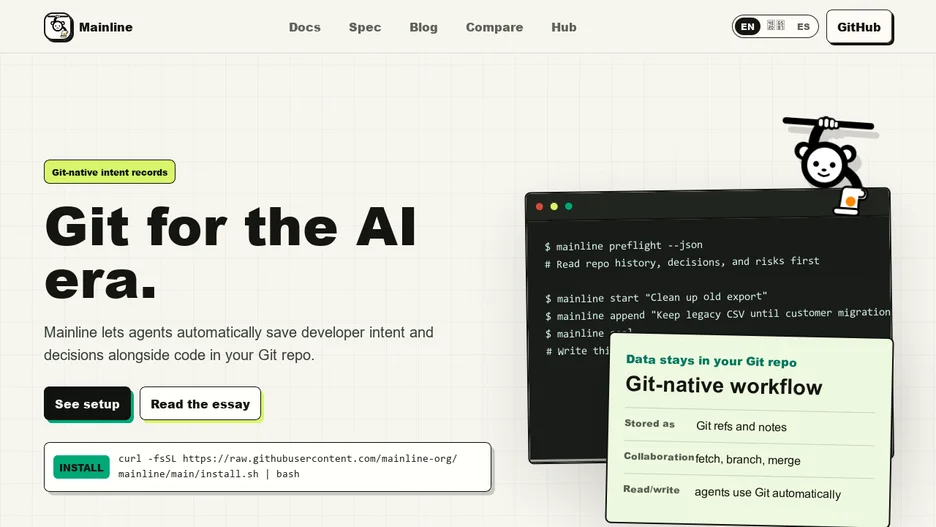
Mainline adds a layer to Git for AI coding agents to record the reasoning behind their work: the original goal, the reasoning path, key decisions and trade-offs, validation performed, explicit constraints, abandoned routes, and the commit that eventually carried the change. Agents read this prior judgment before editing and write new judgment back to Git, so teams do not need to keep long AI transcripts around or run a separate shared memory service.
In practice this lets an agent recognize that an approach, for example routing billing events through a Redis queue, was already tried and abandoned for a specific reason before reviving it; lets one agent see that another has already started an incompatible change to the same product logic before a pull request exists; and surfaces the rollback reason behind code that looks odd, so an agent does not clean it up blindly. Written in Go.