

Mazemaker
A persistent memory system for AI agents that continuously transforms raw conversations into a knowledge graph of atomic facts and their relationships, consolidating and superseding stale facts in the background rather than only retrieving similar text chunks.
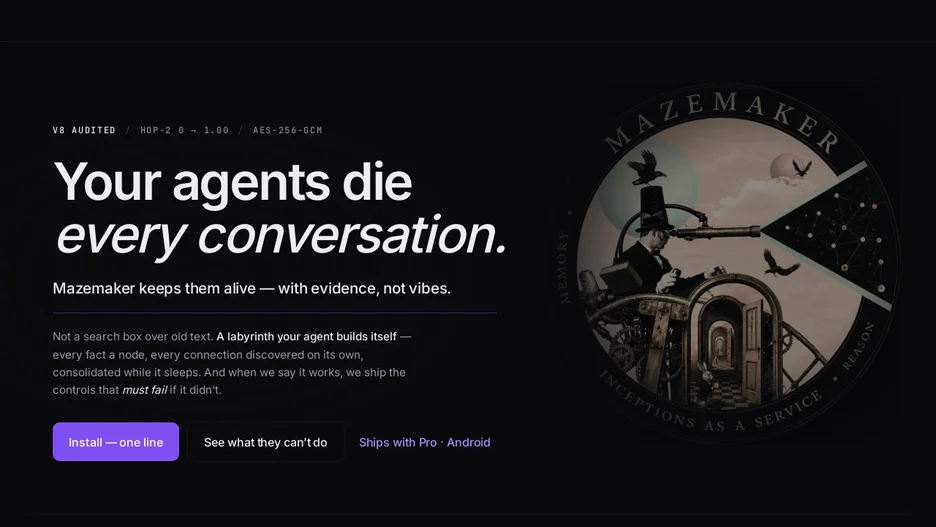
Mazemaker positions itself against memory systems that store text chunks and return the nearest ones by embedding similarity, which it argues cannot follow multi-step reasoning chains, notice that separate facts should be connected, replace a fact once it becomes outdated, or explain why a given memory was recalled. Instead, it continuously turns conversations into a cognitive graph of atomic facts, semantic links, supersession chains for facts that have changed, synthesized abstractions and temporal trajectories, consolidating that graph in the background between sessions rather than only at query time.
On a 500-question, 25,000-memory subset of the LongMemEval benchmark, the project reports 84.26 percent recall at five results and 90.00 percent recall at ten, with a comparison benchmark scoring 94.0 percent across 200 questions. It works with MCP-connected agents and the Hermes Agent framework, and runs locally.
It is written in Python.