

MDFlux
A local-first desktop app that converts PDFs, Office documents and other file formats into clean, AI-ready Markdown, with OCR for scanned pages and batch processing for a whole folder.
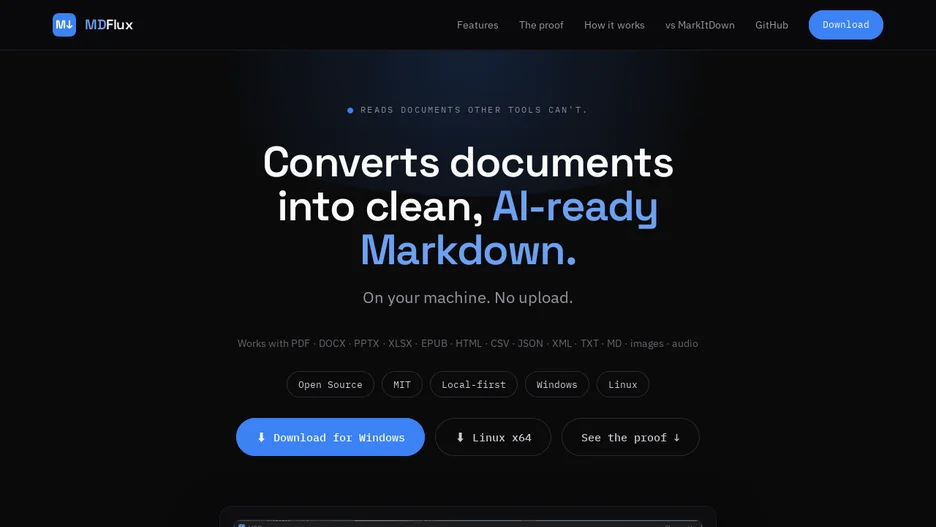
MDFlux turns documents into clean, structured Markdown for feeding to a language model, running entirely on the user's own machine. It reads PDF, DOCX, PPTX, XLSX, EPUB, HTML, CSV, JSON, XML, TXT, Markdown, image and audio files, applies OCR to scanned pages that plain text extraction would otherwise leave blank, can batch-process a whole folder at once, and offers an optional cleanup pass to tidy up messy extraction output.
It is built on Microsoft's MarkItDown conversion engine, with the surrounding tooling that makes it usable day to day. The project's stated motivation is that feeding a document to a vision model as page images is an expensive way to spend tokens, since a page costs a largely fixed number of tokens regardless of how much text it holds, while the same page converted to Markdown is plain text that tokenizes far more cheaply and costs a small fraction as many tokens to read.
It is distributed as a downloadable desktop application for Windows and Linux, with a full download that bundles everything needed and a smaller Lite download that installs remaining components on first launch.