

Memtrace
A structural memory layer for AI coding agents that turns a codebase into a live, bi-temporal knowledge graph of functions, classes and call edges, queryable in milliseconds without an LLM call.
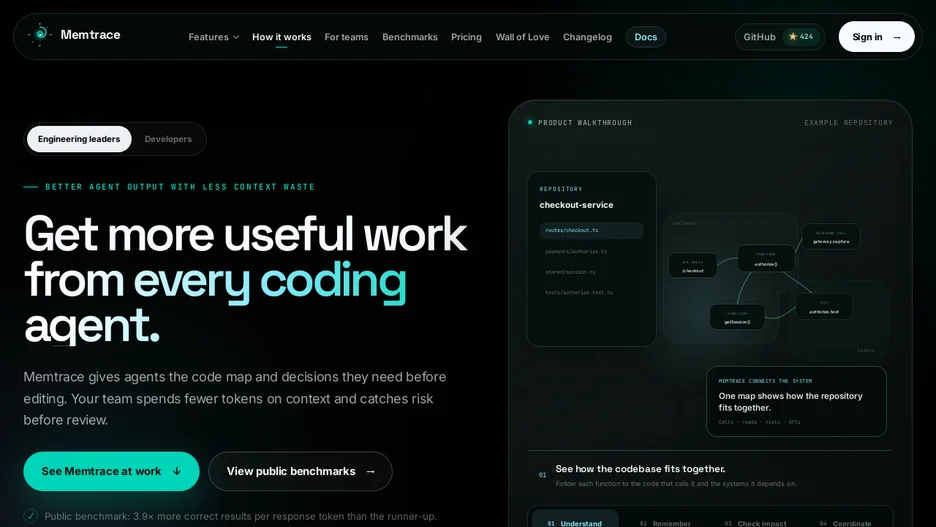
Memtrace indexes a repository with Rust and Tree-sitter across more than 20 languages, plus framework-aware scanners for tools such as Vapor, Lapis, Kong, GitHub Actions, Terraform and RLS policies, and reports indexing a 50,000-file repository in under 90 seconds, entirely locally with no API costs. Because it is structural rather than LLM-generated, several coding agents working on the same repository read the same call graph and blast radius, avoiding merge collisions and stale context.
Being bi-temporal lets a refactor be replayed with full causal awareness of what depended on what and when it changed. A recent addition, LeanCTX Native, adds compression modes on its source-window tool, single-call directory maps, a real-time token-savings dashboard, and an adaptive learner tuned to reduce token use further.
It installs as a plugin for DeepSeek Harness, and also integrates with Cursor, Claude Code, Codex, Hermes, VS Code and Windsurf.