

Mnemosyne
A zero-cloud memory layer, backed by a single SQLite file, that works with any agent framework such as Claude Code, Cursor, Codex or OpenClaw, with one Python dependency and no external services.
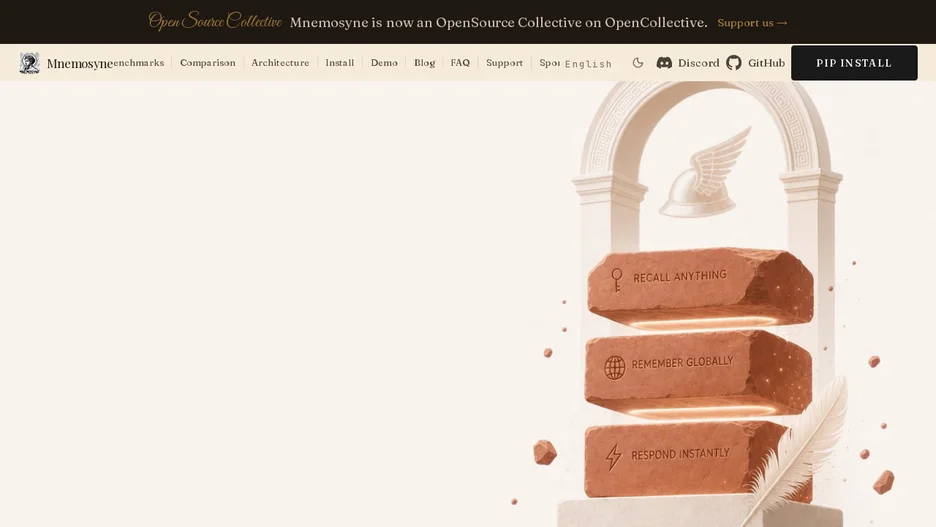
Mnemosyne is a universal memory layer for AI agents, storing everything in one local SQLite database with a single pure-Python dependency and no external services required. It works as an MCP server for clients such as Cursor, Claude Code, OpenAI Codex CLI and Windsurf, as a native tool for OpenWebUI, as an extension for Pi, as a native provider for OpenClaw, and directly through its Python SDK for any Python agent, using remember and recall calls.
It ships native support for Hermes Agent, and is measured on the BEAM benchmark from ICLR 2026, entirely within one SQLite file and with no cloud dependency; a LongMemEval benchmark run is pending. The project documents its benchmark results by version, noting that they are point-in-time measurements rather than a standing claim about the current build.
It installs with pip, optionally with vector search and MCP-server extras, and is written in Python under the MIT license.