

nautilus-compass
An open-source memory and reliability layer for multi-agent setups that keeps agents coordinated without a central orchestrator, combining local long-term memory, drift detection and cross-agent contracts.
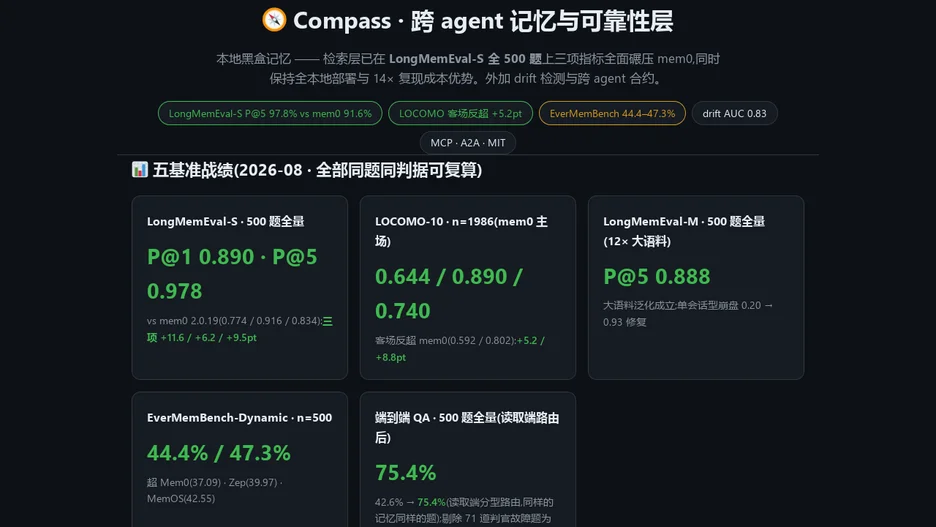
nautilus-compass provides long-term memory for AI agents by embedding raw text locally with a BGE-m3 embedding model, without an extraction language model, a graph, or any data leaving the user's machine. It routes single-session and knowledge-update questions to turn-window chunks and other questions to session-level hybrid retrieval combining BM25 and dense search, and the project publishes a reproducible benchmark comparing its retrieval accuracy against mem0 on the LongMemEval-S and LOCOMO-10 benchmarks.
A second component, drift detection, scores every prompt against a set of known failure patterns before an agent acts, aiming to catch a rule the agent is about to break in the moment rather than only after memory recall. A third component, cross-agent contracts, coordinates multiple agents without requiring a central orchestrator.
It installs as a plugin for Claude Code and Claude Desktop, Cline, Cursor, Continue.dev, Zed, or any MCP client.