

Neural MRI Scanner
A visualization tool that inspects the internals of open-source LLMs the way an MRI images a brain, mapping activations, weight distributions, information flow, and anomalies for a given model and prompt across five scan modes.
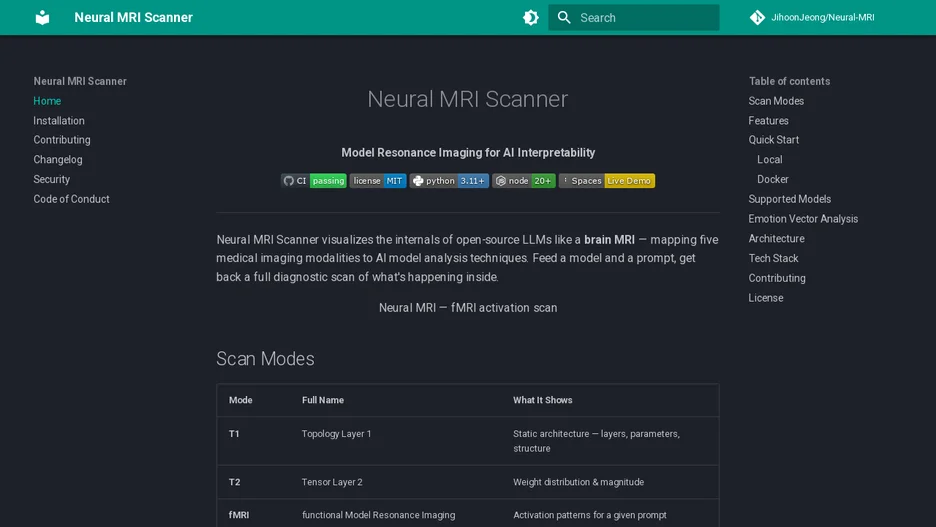
Neural MRI Scanner runs an open-source language model against a prompt and renders five real-time visualizations of what happens inside it: static architecture (T1), weight distribution (T2), activation patterns (fMRI), information flow between components (DTI), and bias, hallucination, or anomaly signals (FLAIR). Token-by-token activations stream over WebSocket as the model generates.
A perturbation engine can zero, amplify, or ablate individual components and measure the effect through KL divergence and logit shift, and a causal-tracing mode compares clean and corrupted prompts with layer-by-layer recovery scores. It integrates Sparse Autoencoder analysis through SAELens and EleutherAI backends, extracts emotion probes to steer model behavior, and can run two models side by side on the same prompt.
It runs as a FastAPI backend with a React frontend, loading TransformerLens-compatible models discovered through the Hugging Face Hub, either locally or with Docker.