

Octopoda
An open-source memory and observability layer for AI agents, adding persistent memory, automatic loop detection, a hash-chained audit trail and a live dashboard on top of a plain Python agent, LangChain, CrewAI, AutoGen or the OpenAI Agents SDK.
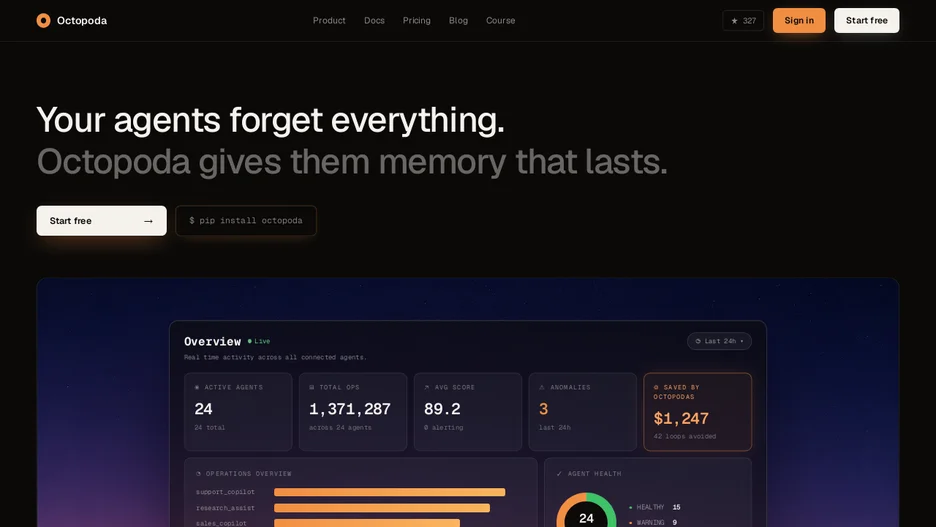
Octopoda sits underneath an existing agent and handles four things agents commonly get wrong: memory that survives restarts, crashes and deployments and is versioned by default; loop detection that flags retry, oscillation, ping-pong, reflection and recall-write patterns within seconds and reports the exact calls that caused them; a hash-chained, verifiable audit trail of every decision, write and recovery; and a live dashboard showing agent health, operation volume and per-agent scores.
It runs locally with one pip install and no infrastructure, and the same code syncs to a paid cloud tier with a single environment variable change, without re-architecting or migrating. Detection runs automatically on every write, while intervention such as auto-pause or a spend cap is opt-in through a circuit-breaker configuration.
The local, MIT-licensed core is free; cloud sync is a paid option.