

OKF Agent Memory
A git-native, domain-neutral persistent memory system for AI coding agents that splits a small always-loaded behavioral codex from a larger knowledge base searched only on demand, to cut prompt bloat without external databases.
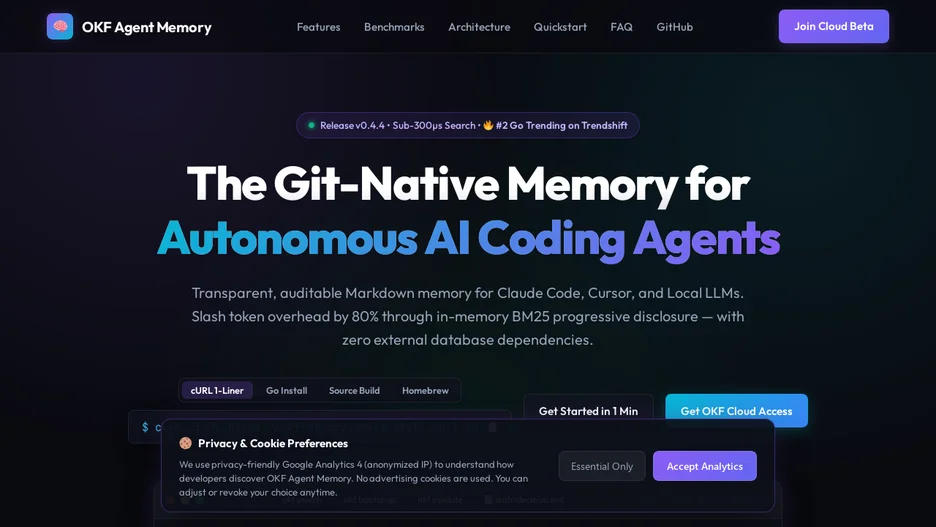
OKF Agent Memory is a persistent project memory system for AI coding agents, implementing version 0.2 of the Open Knowledge Format, built to survive an agent's context window closing and forgetting architectural decisions, domain discoveries and operational facts. It targets two failure modes it identifies in existing approaches: stuffing everything into a single instructions file, which causes context bloat and attention drift, and dumping behavioral rules into a vector database, which agents rarely search for during general tasks.
Its Dual-Memory Agent Architecture splits an agent's configuration into a small, permanent behavioral codex, written in a compact deterministic micro-syntax and loaded at the start of every session, and a separate knowledge bundle that costs no tokens at rest and is queried on demand in microseconds using an embedded, sub-300-microsecond BM25 search. The authors report roughly 80 percent less token use than keeping the same information as prose, and provide a benchmark runner to reproduce the speed and token-reduction claims against a user's own local models.
It is written in Go with no external databases or dependencies, and is compiled into a standalone executable.