

OpenWolf
A local memory and token-accounting layer that keeps task context, a project map, and known fixes available across Claude Code, Codex and OpenCode sessions, without calling any external API.
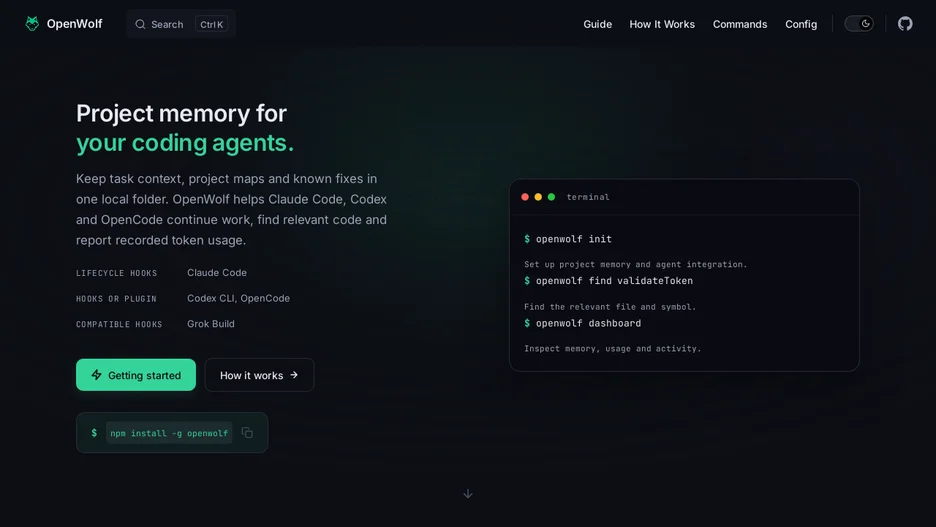
OpenWolf stores a coding project's working memory beside the project itself: the current objective, completed work, unresolved problems and next action are checkpointed so a new session, a restart, or a switch to a different coding agent can pick up where the last one left off. Supported Claude Code and Codex hooks restore this saved context automatically.
It also builds a project map of files and symbols with descriptions, line ranges and import relationships, so an agent can find relevant code without repeated full-file reads, and keeps a running record of provider token counters and estimated model costs grouped by agent and model. A dashboard surfaces hook health and recent activity, and older session notes are archived while active, latest and pinned notes stay available.
All indexing and memory work runs locally, with no telemetry and no calls to external model APIs. It integrates with Claude Code and Codex CLI through hooks and with OpenCode through a plugin, and is licensed under AGPL-3.0.