

Operator!
An alpha-stage terminal application that manages a kanban board of tickets and launches, monitors and pauses multiple AI coding agents against them across many project repositories from one dashboard.
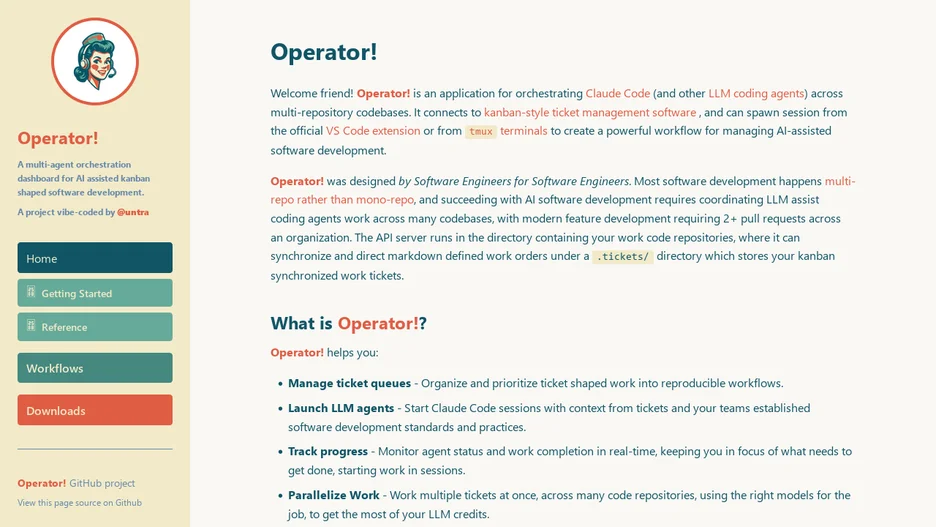
Operator is a terminal user interface that uses session wrappers such as tmux, cmux or Zellij to manage several AI coding agents, including Claude Code, OpenAI Codex or Google Gemini CLI, across a workspace of many codebases at once. It is ticket-first: tickets can come from Operator's own board or sync in from Jira Cloud, Linear or GitHub Projects, and each ticket becomes a markdown story that keys off an agent run.
A queue manager assigns tickets by priority from a dashboard, an orchestration layer launches, monitors and pauses or resumes agents against those tickets while tracking their progress through defined implementation steps, and macOS and Linux notifications keep a developer in the loop on agent events. Started from the root of a collective work directory, Operator scans for marker files such as a project's own agent configuration file to identify local projects automatically. It reaches models through providers such as OpenRouter or a local Ollama server, and version control through a git provider such as GitHub or GitLab; the project describes itself as free to use and in alpha, with a premium tier for remote targets.