

OverGraph
An embedded graph database with built-in vector search that runs inside a host process with no server, combining temporal graph edges, GQL queries and HNSW vector similarity in one Rust engine.
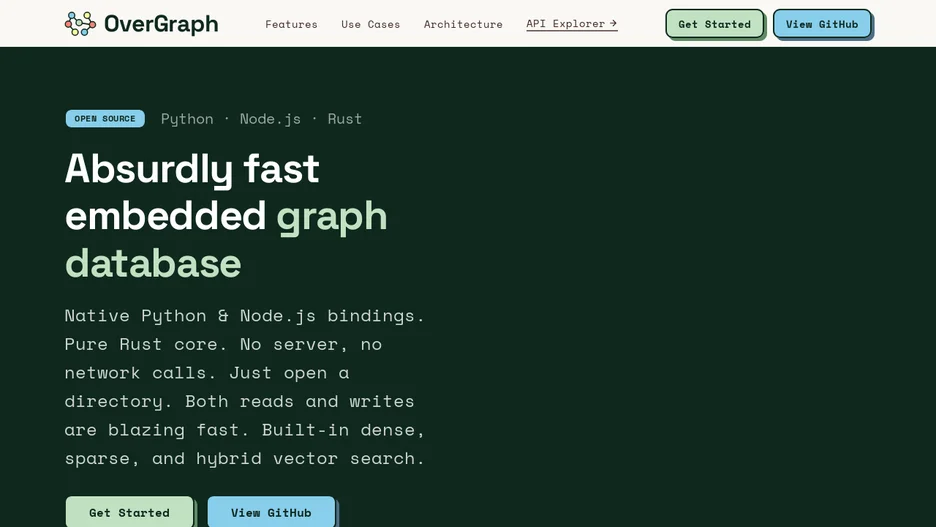
OverGraph is a graph database that runs embedded inside a host process rather than as a separate server: opening a directory gives a full graph database with temporal edges, weighted relationships and built-in vector search, reachable either through function calls in code or through the GQL query language on the same underlying engine.
Graph structure and vector similarity live in the same engine, so a query can ask for similar nodes within a bounded number of hops without a second vector database, using dense HNSW search, sparse keyword vectors such as SPLADE or BGE-M3, and hybrid fusion of both. The project targets AI agent memory with decay scoring for aging out stale context, knowledge graphs with shortest-path and degree-based structure queries, retrieval-augmented generation scoped to graph neighborhoods, collaborative-filtering recommendations through graph traversal, and fraud detection through connectivity analysis.
The core is written in Rust, with native connectors for Node.js and Python, and is licensed under Apache-2.0.