

PageIndex
A retrieval-augmented generation engine that replaces a vector index with a tree structure of a document, letting an LLM reason its way to the relevant section the way a person would.
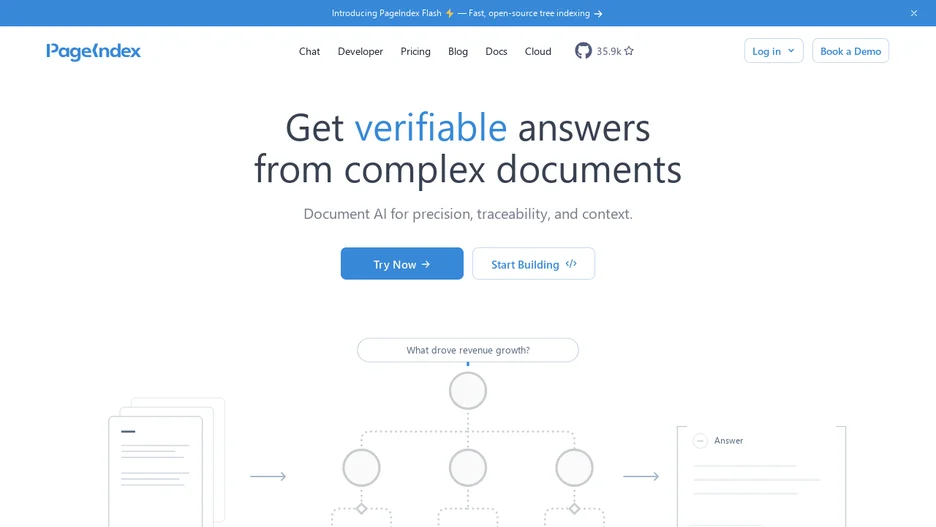
PageIndex generates a hierarchical tree index for each document from its layout, then retrieves an answer by having a language model reason its way through that tree, searching for the section that is genuinely relevant rather than merely similar in embedding space. Because retrieval follows an explicit path through the document's structure, results can be traced back to the specific section they came from, unlike an opaque vector similarity match.
It targets long, complex professional documents such as financial reports, legal documents, regulatory filings, technical manuals and academic textbooks. A companion PageIndex File System extends the same tree-based reasoning across an entire corpus of documents rather than one at a time. It installs as a Python SDK that can run entirely locally with a user's own LLM key, or connect to a hosted PageIndex Cloud API, and its tools can be added to the OpenAI Agents SDK, the Claude Agent SDK, or other agent frameworks.
It is licensed under the MIT license.