

Plasmod
An agent-native database that stores memory, state, events, artifacts and relations as first-class objects, returning structured evidence instead of plain top-k text matches.
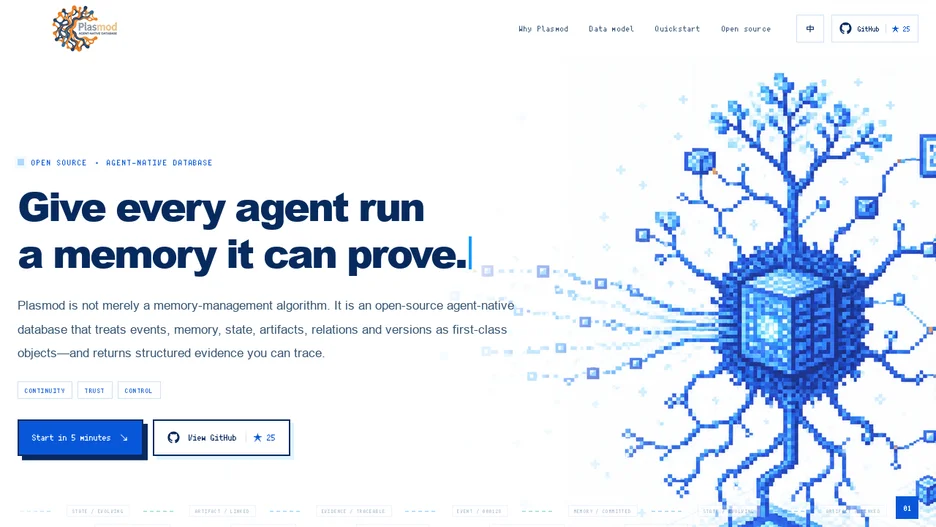
Plasmod is an open-source database built for AI applications and multi-agent systems that need more than similarity search over embeddings. Rather than storing only vectors, it treats memory, state, events, artifacts and relations as first-class objects, so an agent can retrieve not just what happened but what it knows, decided, produced, and how those pieces relate.
It supports event-driven state evolution and provenance-aware retrieval, returning query results with proof traces, source attribution and graph context, which its authors position as useful for RAG systems, long-term agent memory and multi-agent collaboration. Plasmod is written in Go, ships a Python SDK, deploys through Docker, and integrates with LangChain and other AI frameworks.