

Posecode
A text language for describing human movement that can be parsed, validated and rendered in the browser as 3D animation, keeping the semantic decisions behind a motion readable instead of hidden in a black-box trajectory.
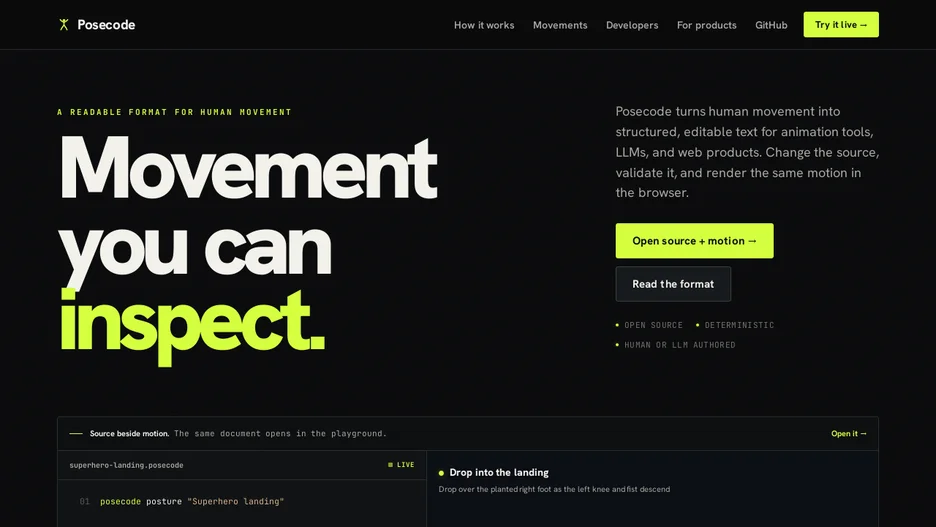
Posecode documents describe motion as joint-level instructions, such as an abduction angle for the shoulders repeated a number of times, that a human can write by hand, an animation tool can emit, or a language model can draft; parsing, validation, editing and rendering all work without invoking an AI model. The project's stated alternative is neural text-to-motion generation, which the README argues is resource-intensive, hard to control with a precise edit such as reducing knee flexion in one phase, and hard to debug when a generated movement looks wrong because there is no readable rule to inspect.
The project provides a live browser playground, a movement library of example documents, a formal language specification, and an MCP server so an LLM client can generate and validate Posecode documents as tool calls.
It is written in TypeScript, renders with Three.js, and is licensed under Apache-2.0.