

Qdrant Cluster Dashboard
A Chrome extension that connects to one or more Qdrant vector database clusters and shows cluster health, collection configuration, shard distribution and performance in real time.
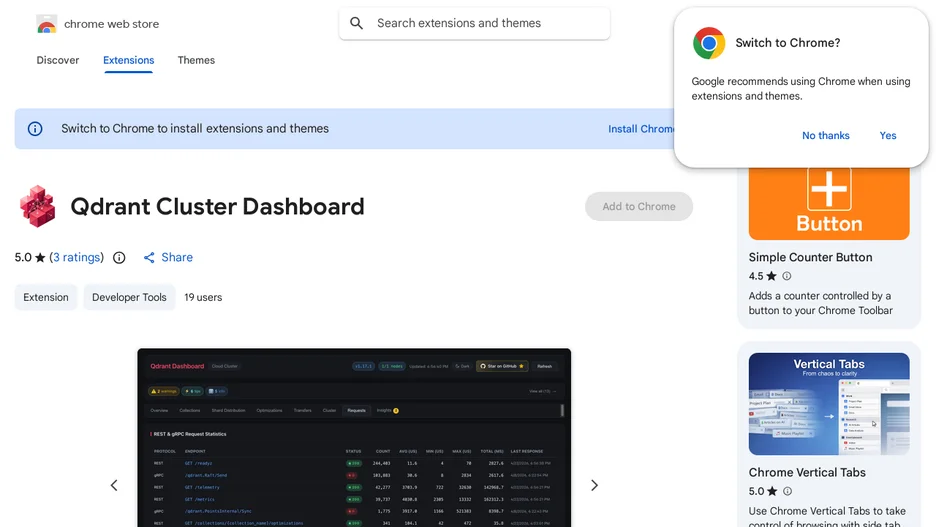
This Chrome extension monitors and manages Qdrant vector database clusters. It reports node and collection counts, memory, CPU and uptime; dense and sparse vector configurations, HNSW parameters, optimizer settings and quantization per collection; per-node shard and segment status; Raft consensus state; and REST and gRPC request latency and counts.
A rule-based insights engine analyzes cluster configuration and flags issues such as high memory usage, missing quantization or payload indexes, and replication or consensus problems, with rules that can be extended.
A Vector Explorer samples real vectors from a collection and projects them to 2D with PCA or UMAP so users can inspect the shape of their embedding space directly in the browser, with payload coloring, faceted filtering and lasso selection, all without a server-side compute step.