

QUAYNOR
A Rust AI inference engine for embedding local large language models in mobile and desktop apps, loading GGUF checkpoints for on-device chat with bindings for Python, Flutter, React Native, Swift and Kotlin.
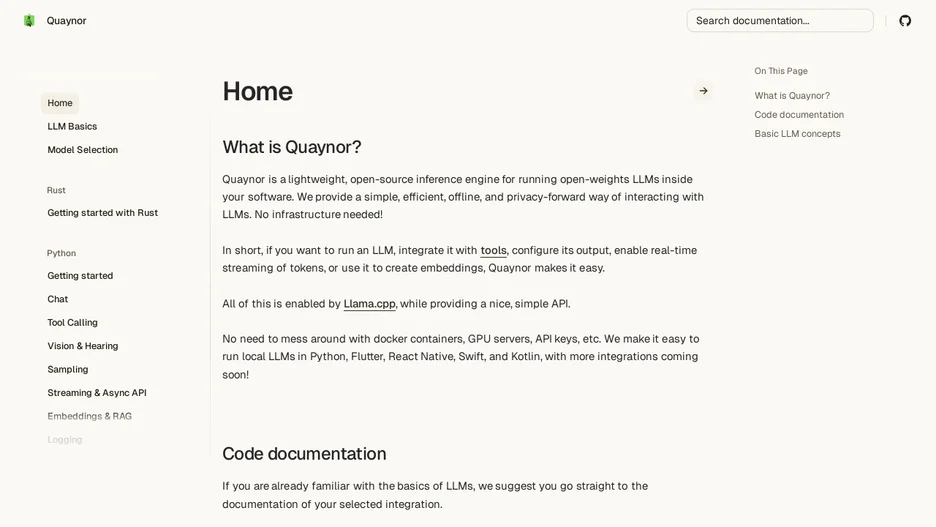
QUAYNOR is a Rust engine that loads GGUF model checkpoints and runs chat inference on-device or on the GPU, keeping data off the cloud, with one chat-style API surfaced consistently across native Rust and bindings for Python, Flutter, React Native, Swift and Kotlin so the same ideas carry over between platforms. The core loads models over Vulkan or Metal where the platform supports a GPU backend, and adds Minijinja-based chat templates, tokenizer helpers, optional embeddings and cross-encoder reranking, and grammar-constrained tool calling.
The shared engine and most bindings live in one Cargo workspace, with the Swift layer as a separate SwiftPM package and the Kotlin layer as a separate Gradle package; the Rust crate itself has no FFI layer, it is the same code that powers every other binding. It needs no inference API keys, since models are loaded from disk or from a URL or Hugging Face path chosen by the developer, and installs from crates.io for Rust or through each platform's own package manager for the other bindings.