

Quivr
A Python library that adds retrieval-augmented generation to an application: ingest files such as PDF, text or Markdown, then ask questions over them using any supported LLM and vector store.
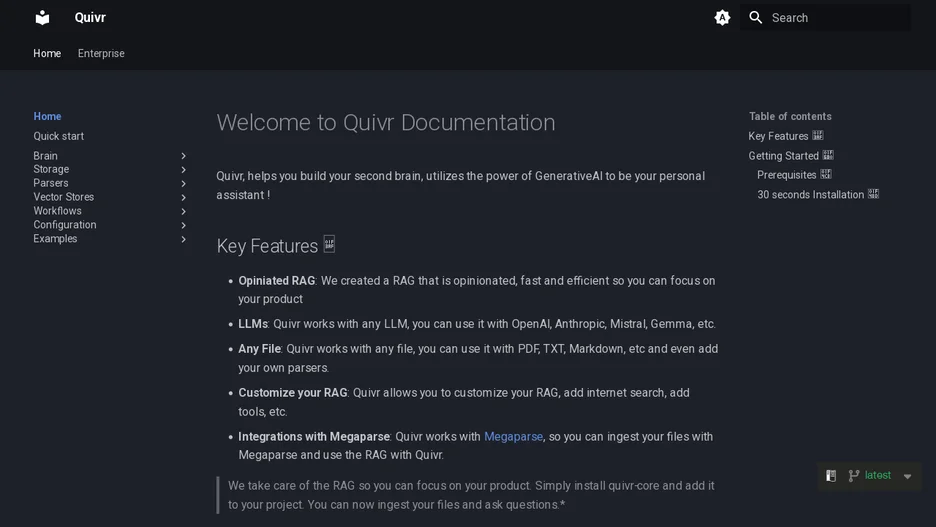
Quivr provides an opinionated retrieval-augmented generation pipeline meant to be installed into an existing product rather than built from scratch. A developer installs the quivr-core package, creates a Brain from a set of files, and queries it, with the retrieval workflow configured through a YAML file.
It works with LLM providers including OpenAI, Anthropic and Mistral, as well as local models through Ollama, and with vector stores such as PGVector and Faiss. It accepts arbitrary file types, including PDF, TXT and Markdown, with support for custom parsers, and integrates with the Megaparse file-ingestion tool. The retrieval pipeline can be extended with internet search and additional tools.
It is written in Python and is the core engine behind the Quivr.com product; the repository states it is licensed under Apache-2.0.