

RAGLight
RAGLight is a lightweight, modular Python framework for Retrieval-Augmented Generation that lets a developer plug in different LLMs, embedding models and vector stores, with built-in MCP integration for external tools and data sources.
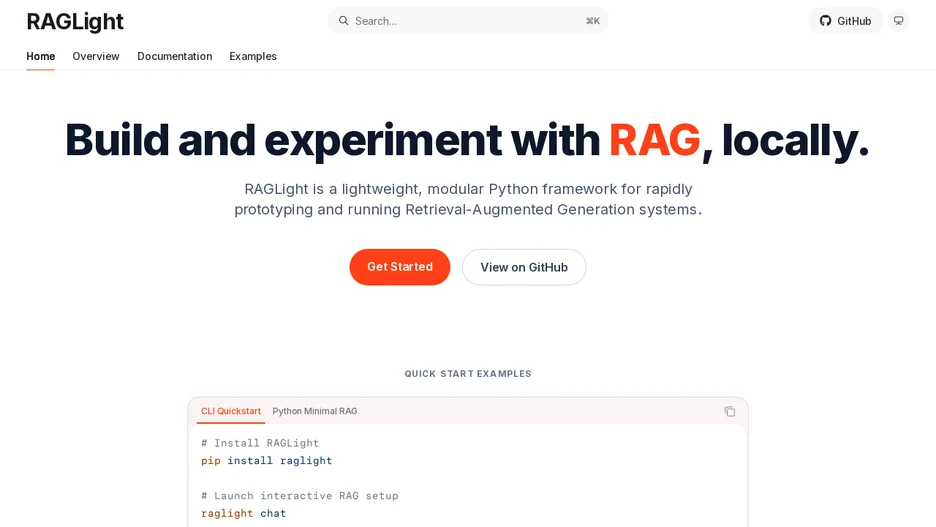
RAGLight combines document retrieval with language-model inference to build context-aware AI applications, with modular components so an LLM, an embedding model or a vector store can be swapped without rewriting the pipeline. It supports LLM providers including Ollama, Google Gemini, LMStudio, vLLM, the OpenAI API, the Mistral API and AWS Bedrock, and can ingest and index document types such as PDF, TXT, DOCX, Python and JavaScript files.
It offers a plain RAG pipeline and an agentic RAG pipeline that uses an agent to improve retrieval quality, MCP integration for external tools such as code execution or database access, hybrid search combining BM25 and semantic search, and query reformulation. A command-line interface can chat with a set of documents directly, or the project can be deployed as a REST API with a chat UI, configured through environment variables and run with Docker Compose.
It is written in Python and distributed under the MIT license.