

RAGWire
A production-grade Python toolkit for retrieval-augmented generation that ingests PDFs, DOCX and XLSX into Qdrant with LLM-based metadata extraction, hybrid search and SHA256 deduplication.
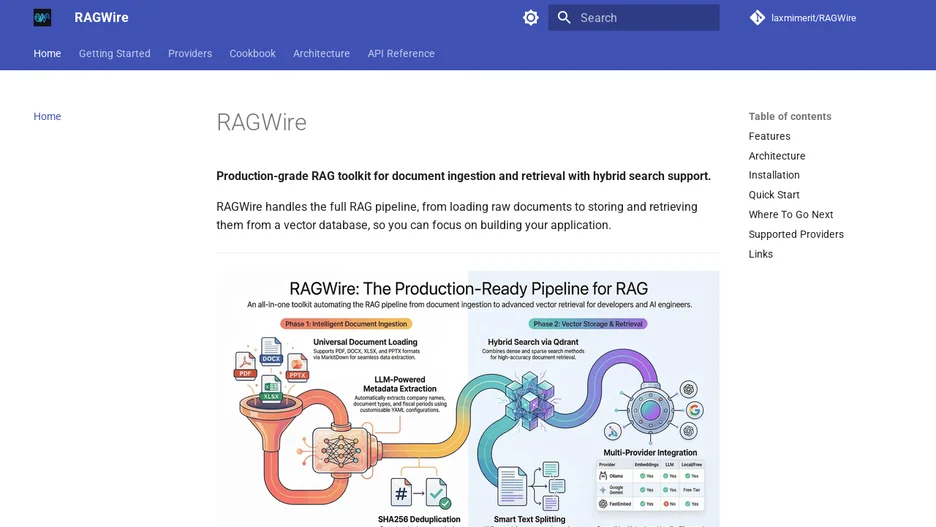
RAGWire provides the building blocks for document-heavy RAG systems without forcing a full application framework: ingestion, metadata extraction, vector storage and retrieval are all configurable and inspectable pieces that can be wired into a user's own apps or agents. It ingests PDFs, DOCX, XLSX, PPTX, Markdown and text files, extracts structured metadata with a chosen LLM, and stores dense and optional sparse vectors in Qdrant.
Retrieval supports metadata filters, maximal marginal relevance, hybrid search and cross-encoder reranking, answers questions with citations while stating when the documents do not contain an answer, and re-running ingestion is safe thanks to SHA256-based deduplication. LLM and embedding providers are swapped through YAML configuration, and it installs with pip against a local or remote Qdrant instance.