

re:factory
A domain-agnostic multi-agent harness for Claude Code that designs and builds software from a plain description, researching the space and drafting a plan before any code is written.
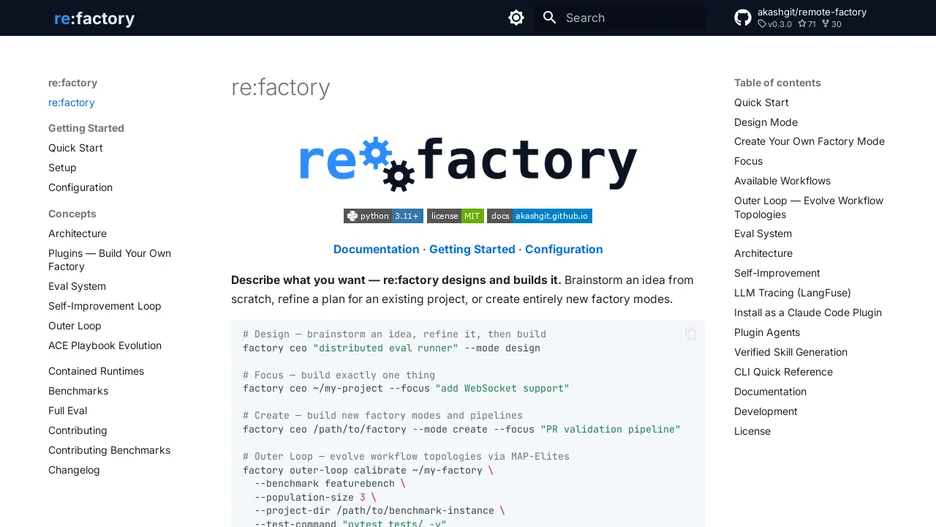
re:factory takes a description of what a user wants and designs and builds it, whether that is brainstorming a new idea from scratch, refining a plan for an existing project, or creating an entirely new working mode for the harness itself. All state is kept local, per-project under a project directory and globally under a home directory.
Its primary mode is Design mode: it researches the problem space, drafts a structured plan through a Strategist role, and lets the user iterate on that plan before any code is written; only after approval does it build and iterate. Input can be a short idea string, a longer spec file with no length limit, an existing project path to study alongside its backlog and evaluation history, or a specific focus area such as a GitHub issue number. A Design-v2 mode applies additional inference-time scaling to the same process.
It requires Python 3.11 or newer, uv, and an installed and authenticated Claude Code, and installs with uv tool install from the project's GitHub repository.