

RushDB
A graph and vector database built on Neo4j that accepts any JSON and returns typed, searchable, relationship-aware records without a schema or migrations, meant as a memory layer for AI agents.
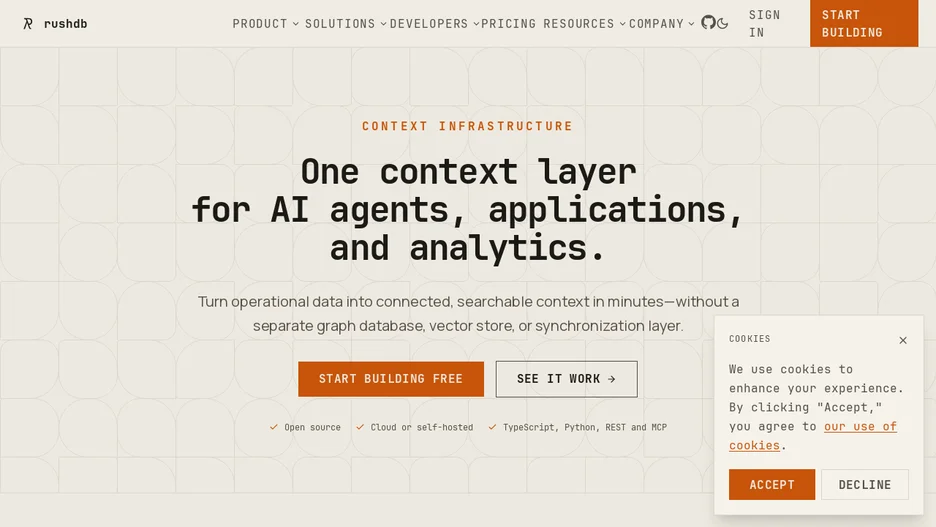
RushDB lets an application push JSON of any shape and get back a live, queryable schema, inferred graph relationships, and semantic search, without designing a schema or writing migrations first. It is meant to replace the usual combination of a key-value cache, a vector store, and a graph database with one system and one API.
Nested objects and arrays in imported JSON become linked records automatically, each nested key becomes a label, and CSV can be imported with automatic type suggestion; embeddings are generated and managed server-side rather than through a separate pipeline. It is available as a managed cloud service or self-hosted with Docker on top of a Neo4j instance, with JavaScript and Python SDKs.
It is written in TypeScript.