

Sovereign Shield
A deterministic AI defense framework that filters and validates inputs and outputs for an autonomous agent, combining keyword and pattern detection, a self-learning adaptive ruleset, and optional multi-model cryptographic consensus for high-assurance verdicts.
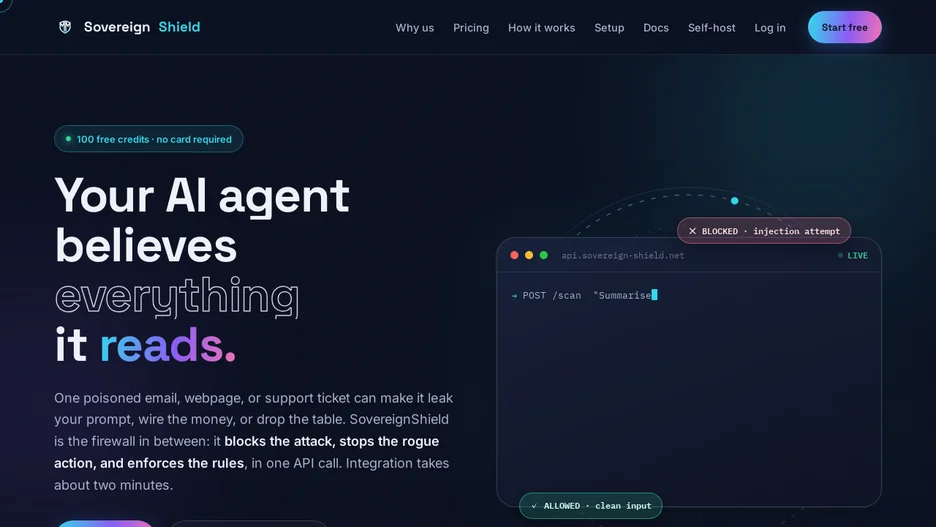
Sovereign Shield is a layered defense pipeline for AI applications: deterministic keyword, encoding, and pattern-detection filters block obvious attacks instantly, a self-learning component called AdaptiveShield builds and validates its own detection rules against historical benign traffic as new attacks are reported, an optional multi-model consensus step has several independent language models agree cryptographically on a structured verdict for ambiguous cases, and a final deterministic validation step checks the language models' own verdict for consistency.
It ships with a safe baseline of nearly 12,000 common words across 15 languages so that everyday vocabulary does not trigger false-positive blocks, and its own security modules are hash-sealed at import time using OS-level memory protection, with that seal re-verified on every evaluation call so a compromised process cannot silently alter the rules it is supposed to enforce. The author describes it as security extracted from their own live, continuously running autonomous agent rather than a prototype.