

txtai
An all-in-one Python framework for semantic search, LLM orchestration and language-model workflows, built around an embeddings database that combines vector search with graph and relational storage.
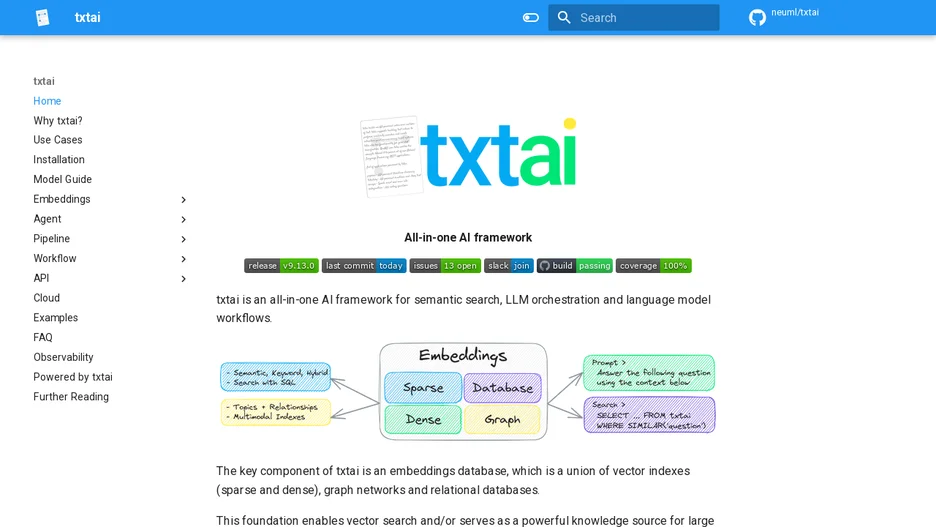
txtai is an all-in-one framework for semantic search, LLM orchestration and language-model workflows. Its central component is an embeddings database, which combines sparse and dense vector indexes, graph networks and a relational database into one store, serving both as a vector search engine and as a knowledge source for LLM applications, autonomous agents, retrieval-augmented generation and multi-model workflows.
It can create embeddings for text, documents, audio, images and video, run pipelines powered by language models for tasks such as question answering, labeling, transcription, translation and summarization, and join those pipelines into workflows that can run as simple microservices or as larger multi-model processes; agents can then connect embeddings, pipelines and workflows together to work through more complex problems on their own. It exposes both a web API and a Model Context Protocol API, with bindings for JavaScript, Java, Rust and Go.
It is built on Python, Hugging Face Transformers, Sentence Transformers and FastAPI, installs with pip or Docker, and can run entirely locally or scale out with container orchestration.