

When to use Graphs in RAG: A Comprehensive Benchmark and Analysis for Graph Retrieval-Augmented Generation
A benchmark and paper repository for evaluating Graph Retrieval-Augmented Generation (GraphRAG) models against traditional RAG, testing hierarchical knowledge retrieval and deep contextual reasoning.
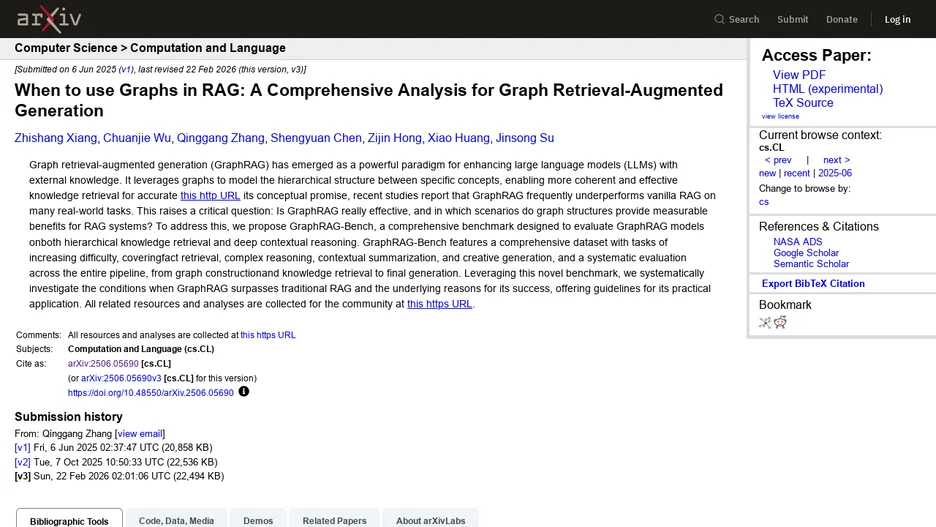
This repository accompanies GraphRAG-Bench, accepted at ICLR 2026, which asks whether graph structures actually help retrieval-augmented generation, since GraphRAG frequently underperforms plain RAG on many real-world tasks despite its conceptual promise. It introduces the GraphRAG concept, compares it against traditional RAG, and states the benchmark's objective: identifying the scenarios where graph structures give a measurable benefit.
The repository also tracks a wider body of related work from the same group, including MemGraphRAG for memory-enhanced RAG, ProbeRAG for RAG faithfulness, LinearRAG for efficient GraphRAG, and DIGIMON for benchmarking flexibly across GraphRAG models, alongside a leaderboard and task examples.