

BrowserAct
A browser automation tool built for AI agents that gets past anti-bot defenses, hands off to a human when stuck, and isolates parallel tasks and accounts.
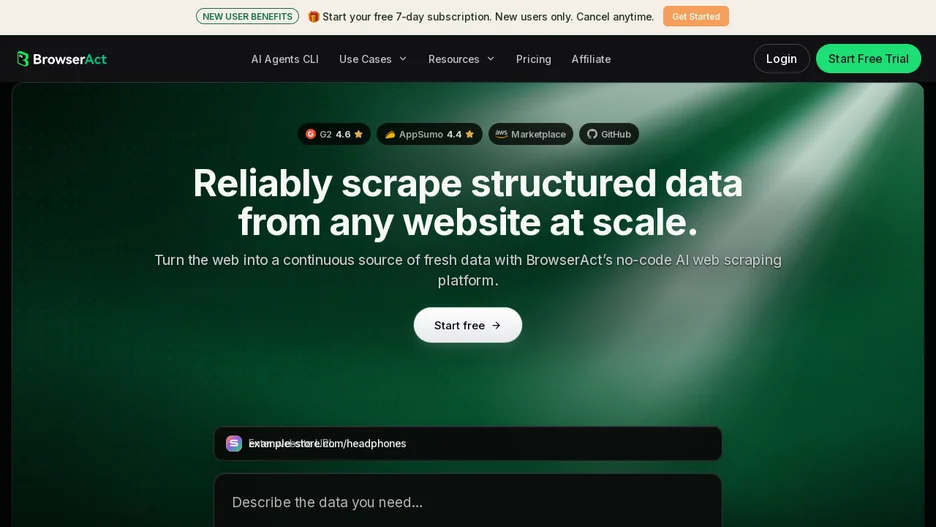
BrowserAct offers two ways to automate a browser: a fully cloud-managed mode where a user describes a target site, filters, and fields, and BrowserAct builds and tests a reusable scraping bot that then runs from the cloud, or a local mode where an agent loads BrowserAct's own skill and drives a local browser directly, including reusing an existing logged-in Chrome profile. It layers defenses against being blocked in stages: an environment layer of stealth fingerprint spoofing, TLS rotation, and proxy switching meant to prevent most blocks outright, an execution layer with commands that auto-solve CAPTCHAs and pull protected pages directly, and a human layer that generates a live URL so a person can take over from any device and hand control back to the agent when done.
Its three browser modes cover reusing local Chrome login state, a frictionless stealth privacy mode for batch scraping without login, and isolated multi-account sessions for parallel, non-interfering tasks.
It is written in Python and distributed under the MIT license.